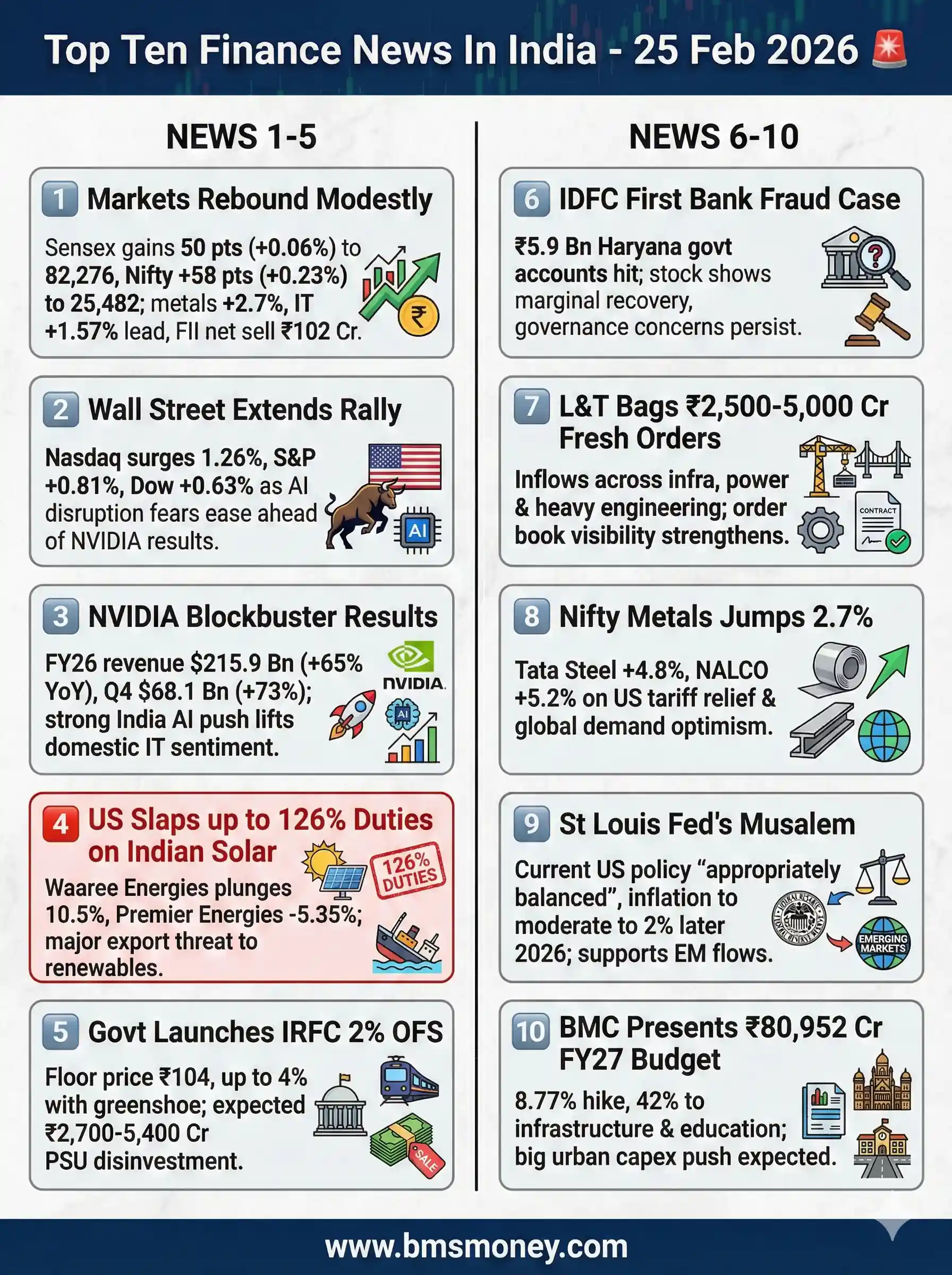
Indian benchmarks staged a modest rebound on February 25, 2026, closing marginally higher as selective buying in IT, metals, and autos helped offset profit booking and renewed FII outflows. Positive global tech cues and eased AI-disruption fears supported sentiment, though US solar duties weighed on renewable energy stocks.
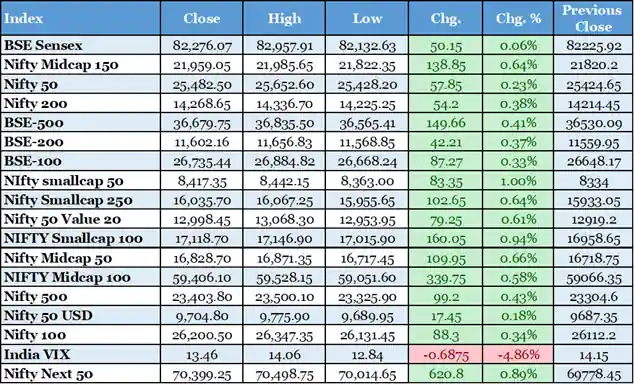
Sensex Ends 50 Points Higher at 82,276; Nifty at 25,482 Amid Late Profit Booking
Indian equity markets opened with renewed vigour on the back of positive overnight cues from Wall Street and a relatively stable rupee, pushing the Sensex up nearly 300 points in early trade and the Nifty briefly crossing the 25,600 mark. However, sustained selling in heavyweight stocks such as Reliance Industries, HDFC Bank, and ITC triggered a gradual erosion of gains from midday onwards. By the close, the Sensex settled just 50 points higher at 82,276 while the Nifty added 58 points to end at 25,482.50, registering a modest 0.23% gain.
Sectoral performance was clearly polarised: the Nifty Metal index surged 2.7%, IT climbed 1.57%, and auto and pharma posted gains of around 1.85% each, while FMCG, PSU banks, and realty closed in the red with losses ranging between 0.6% and 1.1%. Market breadth remained healthy with 1,856 advances against 1,412 declines on the BSE. Foreign institutional investors turned net sellers to the tune of ₹102 crore after three straight days of buying, while domestic institutional investors continued their supportive role with net purchases of ₹1,248 crore.
Analysts noted that the session reflected resilience following the previous day’s 1.2% decline, with strong support emerging at the 25,300-25,350 zone on the Nifty. The immediate implication is that the market is likely to remain range-bound in the near term, with any decisive breakout above 25,650 contingent on sustained global risk appetite and the outcome of the ongoing quarterly earnings season. Traders are advised to monitor the 25,300 support level closely, as a breach could open the downside towards 25,100 in the absence of fresh positive triggers.
US Tech Rally Lifts Wall Street; Nasdaq Surges 1.26% Ahead of NVIDIA Earnings
Wall Street extended its winning streak for a second consecutive session on February 25, 2026, with technology and communication services shares leading the advance as investor concerns over near-term AI disruption eased significantly. The Nasdaq Composite jumped 1.26% to close at its highest level in two weeks, while the S&P 500 rose 0.81% and the Dow Jones Industrial Average gained 0.63%. Mega-cap technology names such as Microsoft, Apple, and Meta Platforms contributed the bulk of the gains amid renewed optimism that artificial intelligence will continue to drive long-term productivity and earnings growth across multiple sectors.
Trading volumes were above average as market participants positioned themselves ahead of NVIDIA’s much-awaited quarterly results after the bell. The VIX volatility index slipped below 14, signalling reduced fear in the options market. Currency markets saw the US dollar index edge lower by 0.2%, providing indirect support to emerging-market currencies including the Indian rupee.
This broad-based US rally served as a crucial supportive global cue for Indian markets, particularly the IT and technology services sector, which accounts for nearly 15% of the Nifty’s weight. The positive sentiment is expected to spill over into Wednesday’s trading session in India, with domestic IT majors likely to open with a gap-up. However, analysts caution that any disappointment in NVIDIA’s guidance could quickly reverse the risk-on mood across global equities.
Investopedia: https://www.investopedia.com/stock-market-today-dow-jones-s-and-p-500-02252026-11913959
NVIDIA Reports Record FY2026 Revenue of $215.9 Billion, Up 65% YoY
NVIDIA Corporation delivered blockbuster financial results for the fourth quarter and full fiscal year 2026, posting revenue of $68.1 billion for Q4 (up 73% year-on-year) and a record full-year revenue of $215.9 billion, representing a 65% increase over the previous fiscal. Data centre revenue alone reached $62.3 billion in the quarter, driven by insatiable demand for its Blackwell and Hopper GPU platforms used in large-scale AI training and inference workloads. Gross margin stood at an impressive 78.1%, reflecting continued pricing power and operational efficiency.
The company also highlighted strong traction in India, noting that leading domestic systems integrators — Infosys, Persistent Systems, Tech Mahindra, and Wipro — are actively building enterprise AI agents and sovereign AI solutions on the NVIDIA platform. CEO Jensen Huang specifically mentioned India’s rapidly expanding hyperscale data centre capacity and the government’s push for AI skilling as key growth drivers for the company’s regional business.
For the Indian market, the results reinforce confidence in the long-term growth trajectory of the domestic IT services industry, which derives nearly 60% of its revenue from the US and is increasingly pivoting towards high-margin AI and generative AI offerings. Stocks such as Tata Consultancy Services, Infosys, and HCL Technologies are expected to see positive re-rating in the coming sessions, with analysts raising target prices by 8-12% on average. The print also validates India’s emergence as a critical node in the global AI supply chain, from chip design services to full-stack AI implementation.
NVIDIA Newsroom: https://nvidianews.nvidia.com/news/nvidia-announces-financial-results-for-fourth-quarter-and-fiscal-2026
US Imposes 126% Preliminary Duties on Indian Solar Imports; Renewable Stocks Slide
Indian solar manufacturing stocks came under severe pressure after the US Department of Commerce announced preliminary anti-dumping and countervailing duties of up to 126% on solar cells and modules imported from India. Waaree Energies plunged as much as 10.5% intraday before closing 8.2% lower, while Premier Energies, Vikram Solar, and KPI Green Energy shed between 4% and 7%. The duties, which are largely aimed at preventing circumvention of existing tariffs on Chinese solar products routed through India, threaten to disrupt the export plans of Indian manufacturers who had been ramping up capacity to serve the US market.
Industry sources indicated that nearly 35-40% of India’s solar module exports in FY26 were directed towards the United States. The move adds to existing trade frictions and comes at a time when domestic solar developers are already grappling with high module prices and slower execution of projects under the PM Surya Ghar scheme. Market reaction highlights the sector’s vulnerability to protectionist policies and underscores the need for greater focus on domestic demand and diversification into newer markets such as Europe and the Middle East.
Analysts expect near-term earnings pressure on pure-play solar manufacturers, with some brokerages downgrading the sector to neutral. Longer term, however, the setback could accelerate policy support for backward integration and encourage Indian firms to accelerate investments in cell and wafer manufacturing under the PLI scheme.
Economic Times (Market Highlights): https://m.economictimes.com/markets/stocks/live-blog/bse-sensex-today-nifty50-stock-market-live-updates-gift-nifty-irfc-voltas-share-price-25-february-2026/liveblog/128767475.cms
Government Launches 2% OFS in IRFC at Floor Price of ₹104 per Share
The Government of India on February 25 initiated an Offer for Sale (OFS) of up to 26.13 crore shares, representing a 2% stake in Indian Railway Finance Corporation Ltd, with a floor price fixed at ₹104 per share. An additional 2% greenshoe option has also been retained, which could take the total stake sale to 4% if fully exercised. The OFS is scheduled to close on February 26 and is expected to fetch the government between ₹2,700 crore and ₹5,400 crore depending on final subscription and price discovery.
This divestment is part of the Centre’s ongoing programme to unlock value from profitable public sector undertakings and aligns with the disinvestment target of ₹50,000 crore for the second half of FY26. IRFC, which enjoys a near-monopoly in funding Indian Railways’ rolling stock and infrastructure projects, has delivered consistent profitability and dividend payouts, making it an attractive candidate for stake sale.
Market participants expect healthy participation from both domestic and foreign institutional investors given the company’s strong order book visibility and sovereign backing. Successful completion of the OFS would improve free-float and liquidity in the counter while signalling continued government commitment to calibrated PSU monetisation. The stock is likely to witness volatility during the offer period but is expected to find strong support post-listing of the new shares.
IDFC First Bank Fraud Case Spotlights Persistent Trust Deficit in Banking Sector
Shares of IDFC First Bank showed only a marginal recovery on February 25 after the 16% plunge recorded two days earlier following the disclosure of a suspected ₹5.9 billion fraud involving fictitious accounts linked to Haryana government departments. Although the bank has stated that the entire amount has been fully provisioned and that the incident was confined to a single branch with no systemic failure, investor confidence remains shaken.
The episode has reignited broader concerns around governance standards and internal controls at mid-sized private sector banks, especially those that have pursued aggressive retail and SME lending strategies in recent years. Credit rating agencies have maintained stable ratings but have flagged the need for enhanced monitoring of government-related exposures. Brokerages have trimmed their target prices by 5-8% on average, citing elevated regulatory and reputational risks.
The development comes at a time when the broader banking sector is already navigating tighter liquidity conditions and rising deposit competition. While large private banks with robust compliance frameworks are expected to remain insulated, the incident could lead to heightened due diligence by investors across the mid-cap banking space for the next several quarters.
Reuters Breakingviews: https://www.reuters.com/commentary/breakingviews/india-bank-selloff-exposes-trust-deficit-2026-02-25/
L&T Secures Fresh Orders Worth ₹2,500-5,000 Crore Across Segments
Larsen & Toubro announced the receipt of multiple new orders valued between ₹2,500 crore and ₹5,000 crore during the month of February across its various business verticals including heavy engineering, infrastructure, and power transmission. The orders encompass EPC contracts for metro rail signalling, renewable energy evacuation systems, and critical process equipment for the hydrocarbons sector.
This inflow adds to L&T’s already robust order book, which stood at ₹4.2 lakh crore at the end of December 2025, providing strong revenue visibility for the next 24-30 months. The company’s diversified presence across high-growth areas such as data centre infrastructure, green hydrogen, and defence continues to differentiate it from pure-play construction peers.
Brokerages have maintained “Buy” ratings with upward revisions to earnings estimates by 3-5% following the announcement. The development reinforces the narrative of sustained capital expenditure momentum in core infrastructure and manufacturing sectors, which is expected to benefit the entire capital goods ecosystem in the coming quarters.
Economic Times (Market Highlights): https://m.economictimes.com/markets/stocks/live-blog/bse-sensex-today-nifty50-stock-market-live-updates-gift-nifty-irfc-voltas-share-price-25-february-2026/liveblog/128767475.cms
Metals Pack Advances 2.7% on Global Demand Optimism After Tariff Relief
The Nifty Metal index posted a strong 2.7% gain on February 25, led by sharp rallies in Tata Steel (up 4.8%), National Aluminium (up 5.2%), and Hindalco Industries (up 3.1%). The upmove was triggered by news that the US Supreme Court struck down certain sweeping tariffs on steel and aluminium imports, easing immediate concerns over global trade disruptions and supporting expectations of improved demand from key consuming regions.
Global commodity prices also reacted positively, with London Metal Exchange aluminium and copper futures rising 1.8% and 1.4% respectively. Domestic steel producers are expected to benefit from both higher realisations and stable input costs amid softening coking coal prices.
Analysts believe the sectoral outperformance could sustain in the near term provided global growth signals remain constructive. The move also provides a timely boost to India’s metal exporters, who had been facing margin pressure due to earlier tariff uncertainties and Chinese overcapacity concerns.
Economic Times (Market Highlights): https://m.economictimes.com/markets/stocks/live-blog/bse-sensex-today-nifty50-stock-market-live-updates-gift-nifty-irfc-voltas-share-price-25-february-2026/liveblog/128767475.cms
St. Louis Fed’s Musalem Says Current US Policy Appropriately Balances Risks
St. Louis Federal Reserve President Alberto Musalem stated on February 25 that current US monetary policy settings are appropriately positioned to balance risks to the inflation and labour-market outlooks. In prepared remarks, Musalem noted that his baseline forecast continues to see inflation moderating towards the 2% target later in 2026, with the labour market remaining resilient but not overheated.
The measured tone from the influential regional Fed president helped sustain global risk appetite and limited selling pressure on emerging-market assets. The Indian rupee traded in a narrow 83.45-83.62 band against the dollar, while 10-year Indian government bond yields eased 3 basis points to 6.78%.
Market participants interpreted the comments as reducing the probability of aggressive rate hikes in the near term, thereby supporting capital flows into high-yielding emerging markets including India. The remarks also provided a counter-narrative to more hawkish comments from other Fed officials earlier in the week.
BMC Presents ₹80,952 Crore Budget for FY27 with Focus on Infrastructure and Education
The Brihanmumbai Municipal Corporation (BMC) presented its annual budget of ₹80,952 crore for fiscal year 2026-27, marking an 8.77% increase over the previous year’s outlay. A significant portion — nearly 42% or ₹34,000 crore — has been allocated towards infrastructure projects including road widening, coastal road extensions, and metro connectivity. Education and health received enhanced funding of ₹12,500 crore and ₹9,800 crore respectively, with major emphasis on smart classrooms and primary healthcare strengthening.
The budget is expected to generate substantial multiplier effects for the construction, cement, steel, and allied sectors within Maharashtra and neighbouring states. Several listed companies in the urban infrastructure and real estate development space are likely to see improved order inflows over the next 12-18 months.
Analysts view the higher capital expenditure as supportive of the Centre’s broader urbanisation and “Viksit Bharat” agenda, with positive implications for listed players such as IRB Infrastructure, ACC, and UltraTech Cement that have significant exposure to Maharashtra projects.
CNBC-TV18 (via LinkedIn Top Stories): https://www.linkedin.com/pulse/top-stories-snaps-5-day-losing-run-duty-indian-solar-gear-pm-vwerc
This briefing captures the dominant themes of February 25: selective domestic recovery supported by global tech optimism, tempered by trade frictions in renewables, and steady progress on policy and corporate fronts. Markets are expected to remain data-dependent with focus shifting to upcoming corporate earnings and global central-bank commentary.