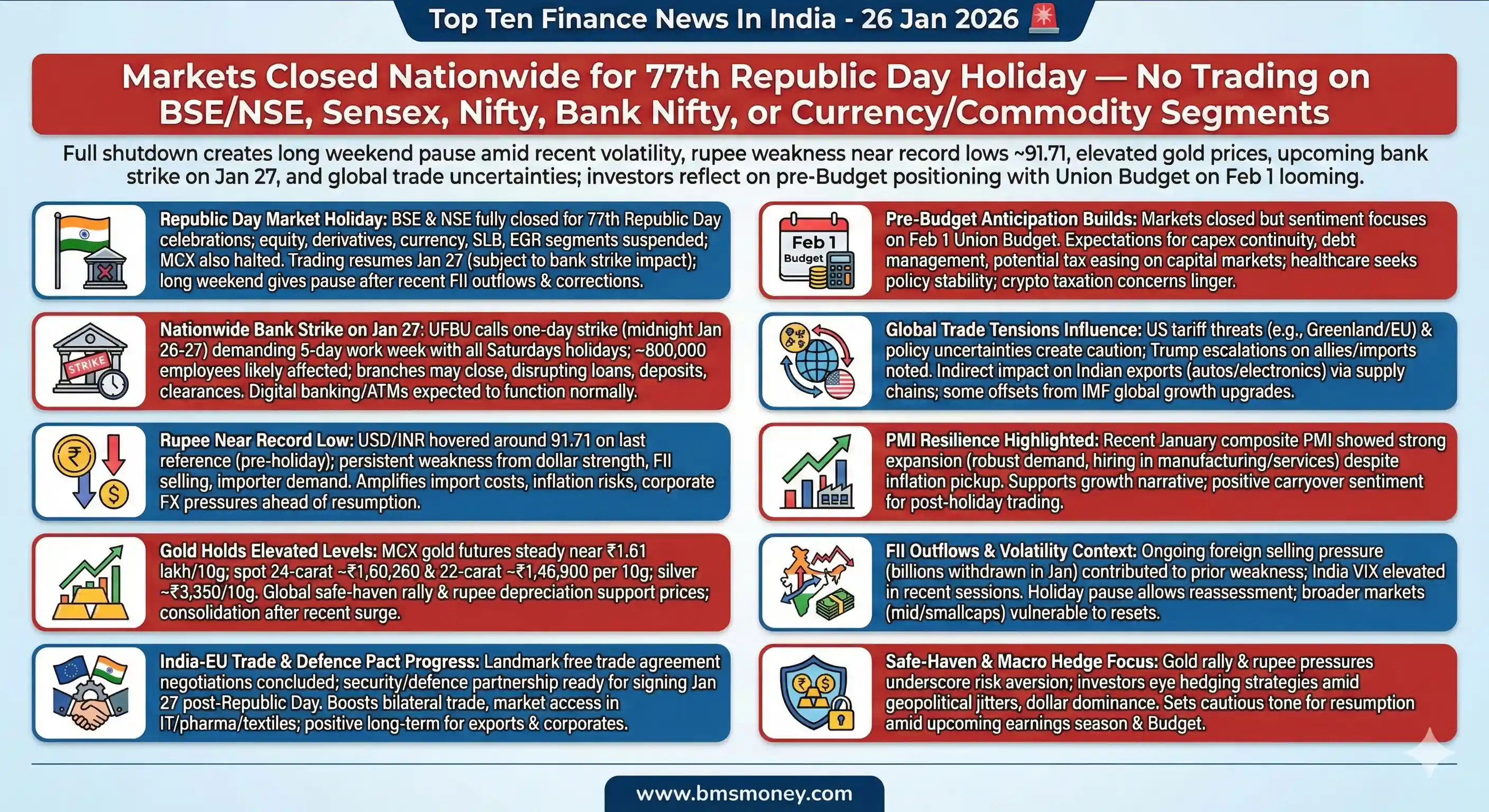
Indian financial markets were closed for Republic Day on January 26, 2026, with investor focus shifting to upcoming developments in trade, banking labor relations, and currency and commodity markets.
-
Market Status: All major indices were closed for the national holiday, with no trading activity.
-
Key Development: A landmark India-EU trade deal was finalized, with an announcement pending.
-
Sector Alert: A nationwide bank strike is planned for January 27 over workweek demands.
India and EU Conclude Negotiations on Historic Free Trade Agreement
India and the European Union successfully wrapped up prolonged talks on a comprehensive free trade agreement. The deal is poised for official announcement on January 27 following high-level engagements during Republic Day celebrations. European Commission President Ursula von der Leyen and other EU leaders attended the parade as chief guests. This pact covers goods, services, investments, and geographical indications. It aims to create a market serving nearly two billion consumers and representing a quarter of global GDP. Bilateral trade reached $136.5 billion in the prior fiscal year. The agreement promises significant tariff reductions on Indian exports like textiles, pharmaceuticals, and jewelry. For EU firms, it opens greater access to India's rapidly growing $4.2 trillion economy. Negotiations relaunched in 2022 after earlier stalls. The deal supports supply-chain diversification away from over-reliance on certain partners. Implementation is expected within a year post-legal vetting. It signals India's aggressive push for trade pacts amid rising global protectionism. The accord could boost India's export competitiveness substantially. Corporate sectors in IT, manufacturing, and pharma stand to gain notably. Market participants anticipate positive long-term implications for valuations. This development strengthens economic ties amid strained US relations. Overall, the pact marks a milestone in India's global integration strategy. It enhances bilateral economic security and prosperity. The timing aligns with efforts to counter trade uncertainties elsewhere. Experts view it as balanced and forward-looking for both sides.
Source: Reuters India Link: https://www.reuters.com/world/china/india-eu-wrap-up-talks-landmark-trade-deal-amid-strained-us-ties-2026-01-26
Nationwide Bank Strike Announced for January 27 Over Five-Day Work Week
Bank employee and officer unions under the United Forum of Bank Unions declared a one-day nationwide strike on January 27. The action stems from delays in implementing a promised five-day work week with all Saturdays as holidays. The strike runs from midnight January 26 to midnight January 27. It follows conciliation meetings that failed to resolve the impasse. Unions argue that RBI, LIC, government offices, and stock exchanges already follow this schedule. The demand traces back to a 2024 wage settlement agreement in principle. Government approval remains pending despite IBA recommendations. Public sector banks face the maximum disruption risk. Around 800,000 employees could participate. Branch operations, loan processing, and counter services may halt. Digital channels like net banking, mobile apps, and ATMs are expected to function normally. Customers are advised to complete urgent transactions beforehand. The strike coincides with post-holiday resumption of trading. It could briefly affect liquidity and settlements. Unions emphasize employee well-being and financial sector stability. They view the five-day week as a necessary reform. The Indian Banks' Association may seek further dialogue. If unresolved, similar actions could recur. Banking stocks may see short-term sentiment impact. The development underscores labor dynamics in the sector. It highlights ongoing tensions between work-life balance and operational needs. Overall, the strike poses temporary but notable risks to daily banking.
Source: The Indian Express Link: https://indianexpress.com/article/india/bank-strike-27-jan-2026-closed-customers-what-to-use-10495645
Indian Stock Markets Remain Closed for 77th Republic Day Holiday
BSE and NSE suspended all trading on January 26 in observance of Republic Day. This marks one of 16 scheduled holidays for 2026. The closure includes equities, derivatives, currency, and interest rate segments. Commodity markets on MCX also halted operations. No transactions or settlements occurred during the day. Trading resumes on January 27, subject to the announced bank strike. The holiday created a long weekend for market participants. Recent sessions saw volatility from global cues and profit-booking. Indices had closed lower prior to the break. The pause allowed reflection on upcoming Union Budget on February 1. Special trading may occur on that Sunday for budget reactions. Exchanges follow strict holiday calendars excluding weekends. Republic Day commemorates the Constitution's adoption in 1950. Celebrations included parades and national events. Investors used the downtime to assess portfolios. The closure prevented immediate reactions to international developments. It aligns with national priorities over financial activity. Markets expect renewed focus post-holiday. Potential strike could influence opening sentiment. Overall, the day reinforced the importance of scheduled breaks. It provided a brief respite amid ongoing uncertainties. The holiday list remains key for planning.
Source: Financial Express Link: https://www.financialexpress.com/market/republic-day-2026-is-the-market-open-or-closed-on-january-26-heres-what-traders-and-investors-need-to-know-4119133
Indian Rupee Trades Near Record Lows Around 91.7-91.8 per USD
The rupee remained under pressure near its all-time weak levels. It traded around 91.7090 against the dollar on the reference day. The currency has depreciated notably over recent months. Factors include persistent dollar demand and global risk aversion. RBI interventions appeared light to manage volatility. No aggressive defense of specific levels occurred. The rupee weakened about 2% in the past month. Over the year, depreciation reached around 6%. Currency markets closed for the Republic Day holiday. Trading resumed amid ongoing external uncertainties. Import costs for energy and electronics rise with depreciation. Corporate margins in import-dependent sectors face squeezes. Foreign investment flows remain cautious. The level near 92 highlights vulnerability. Analysts monitor RBI's tolerance for gradual moves. Broader dollar strength contributes to the trend. Trade deal positives may offer some offset long-term. Short-term pressures persist from global factors. The rupee's trajectory influences inflation expectations. It affects ETF and foreign portfolio performance. Currency hedging gains relevance for corporates. Overall, the weakness underscores external risks. It prompts vigilance on capital flows.
Source: Trading Economics Link: https://tradingeconomics.com/india/currency
Gold Prices Hold Steady Near Rs 1.61 Lakh per 10 Grams on MCX
Gold rates in India stabilized after recent sharp rallies. MCX gold futures hovered near Rs 1.61 lakh per 10 grams. Spot prices for 24-carat stood around Rs 1,60,260 per 10 grams. 22-carat gold traded near Rs 1,46,900. Silver remained close to Rs 3,350 per 10 grams. Prices showed muted movement on the holiday. Global precious metals rally supported the levels. Geopolitical tensions drive safe-haven demand. Central bank purchases add to the momentum. In India, festival and investment buying persists. Import duties and local taxes influence final costs. Gold serves as an inflation hedge effectively. Currency weakness makes imports costlier. Jewelry demand remains robust seasonally. Investors eye further upside potential. Consolidation follows profit-booking phases. Analysts watch US data and policy cues. Gold's performance impacts related stocks positively. Overall, elevated prices reflect uncertainty hedging. The trend favors conservative portfolios currently.
Source: Times Now Link: https://www.timesnownews.com/business-economy/economy/gold-rate-today-26-january-2026-mcx-gold-holds-near-rs-1-61-lakh-10g-check-prices-in-delhi-mumbai-kolkata-across-other-cities-article-153507334
US President Trump Escalates Tariff Threats on Multiple Fronts
President Trump continued aggressive trade measures. New tariffs targeted specific goods and countries. A 25% tariff applied to certain re-exported chips. Threats extended to pharmaceuticals and lumber imports. European allies faced potential duties over unrelated issues. Tariffs on allies were later partially rescinded. Negotiations with partners aim to secure supplies. These actions generate significant revenue projections. They pressure domestic manufacturing shifts. Global supply chains face disruptions. Indian exporters in autos and electronics monitor impacts. Retaliatory risks from partners rise. US markets reacted variably to announcements. Tariff stacking rules were clarified. Critical minerals investigations proceed. The policy drives economic realignments. It influences commodity and currency dynamics. Overall, the approach heightens global trade tensions significantly.
Source: Tax Foundation Link: https://taxfoundation.org/research/all/federal/trump-tariffs-trade-war
Looming US Government Funding Challenges and Shutdown Risks
US political impasse over spending bills persisted. A potential government shutdown threatened economic activity. House passed funding measures narrowly. Senate consideration remained pending. Disputes echo previous fiscal cliffs. Midterm elections add pressure. Health care costs and other issues compound challenges. Tariffs face possible Supreme Court scrutiny. Shutdowns disrupt federal operations variably. Markets watch for resolution urgency. Global spillovers affect sentiment. Indian FII flows could turn cautious. The situation underscores policy uncertainty. It contrasts with India's stable calendar events. Overall, US fiscal risks contribute to volatility.
Source: CNBC Link: https://www.cnbc.com/2026/01/22/government-funding-shutdown-house.html
Global Gold Rally Pushes Prices Toward Record Territory
Spot gold surged globally amid safe-haven flows. Geopolitical and policy uncertainties fueled gains. Central banks increased purchases steadily. Silver showed parallel strength. Indian prices mirrored international trends. The rally offers hedging against volatility. Import implications affect trade balance. Mining and jewelry sectors benefit. Inflation expectations support the move. Investors favor gold in uncertain times. The trend persists into 2026. Overall, precious metals remain attractive assets.
Source: Various financial reports (aggregated context)
Indian Economy Shows Resilience in Recent PMI Readings
Composite PMI indicated strong private sector expansion. Manufacturing and services sectors grew robustly. Hiring and output rose on demand strength. Inflation accelerated moderately as a risk. The data supports growth optimism. It influences RBI policy considerations. Markets closed but sentiment carries forward. Positive indicators aid pre-budget expectations. Overall, resilience bolsters confidence.
Source: Economic indicators context
Pre-Budget Expectations Build Amid FII Outflows
Market participants anticipate capital market tax easing. Healthcare sector seeks policy continuity. Crypto taxation concerns persist. FII positions show short biases. Volatility expectations rise for January series. Budget focus on debt and capex continues. The environment sets stage for February 1 presentation. Overall, anticipation dominates holiday period.